What if the Universe didn’t start with a singular “Bang,” but instead collapsed, bounced, and expanded again—and the evidence is still around us today?
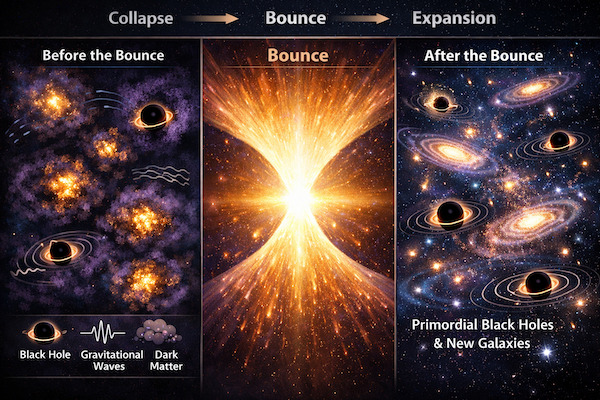
In Cosmological Bounce Relics: Black Holes, Gravitational Waves, and Dark Matter, cosmologist Enrique Gaztañaga proposes a striking mechanism: in a bouncing-Universe scenario, the collapsing phase before the bounce could naturally manufacture cosmological relics—especially black holes—that survive into the expanding Universe we live in now. These relics might explain three major puzzles at once:
-
What dark matter is
-
Why there are so many black holes
-
How supermassive black holes appeared so early
The core idea: relics from a pre-bounce collapse
In standard cosmology, a lot of attention goes to primordial black holes (PBHs) formed shortly after the Big Bang from rare, extreme density spikes. But PBHs face a big practical problem: under common assumptions, those density spikes are too rare to make enough black holes to be all (or much) of dark matter, and many mass ranges are tightly constrained by observations.
Gaztañaga flips the storyline.
Instead of relying on “lucky” early spikes, he argues that during a pre-bounce collapsing era, gravity would have had time to grow structure nonlinearly—more like the way galaxies and dark matter halos form in the usual expanding Universe, but in reverse. Then, the bounce happens. And crucially, some structures can effectively “freeze” when they become larger than the horizon and later re-enter after the bounce.
That re-entry moment is the trapdoor: once a previously-formed overdense object re-enters causal contact, it can collapse extremely fast into a black hole.
Two production channels for “Bounce Dark Matter”
The paper names this scenario Bounce Dark Matter (BDM), and it comes in two routes:
1) Horizon-reentry channel (halos that turn into black holes later)
During collapse, collisionless matter (dark matter-like matter) can clump into virialized halos—basically gravitationally bound structures that stop collapsing further because their internal motions build up “effective pressure” through orbital mixing.
Now comes the bounce twist: if a halo becomes bigger than the horizon before the bounce, it can survive the bounce as a coherent object. After the bounce, as the horizon grows, that halo re-enters… but it re-enters already extremely overdense compared to what’s needed for rapid black hole formation. Result: it collapses into a black hole almost immediately on re-entry.
This differs from inflationary PBHs because the overdensity here is not a rare primordial spike—it’s the end product of ordinary nonlinear structure growth during collapse.
2) Horizon-shielded channel (compact objects that “ride through” the bounce)
In the second path, some matter might already form compact objects (like black holes or neutron stars) during the collapsing era. If they’re sufficiently “large-scale” compared to the bounce’s causal horizon, they can pass through the bounce phase largely intact and show up afterwards as relic black holes.
A surprising “survival threshold”
A key claim is that objects or perturbations larger than roughly ~90 meters in physical scale can survive the bounce as super-horizon relics and later reappear in the expanding phase.
That sounds tiny on human scales, but cosmologically it’s huge: it implies a very broad menu of survivable structures, from compact objects to gravitational-wave patterns.
Why this is exciting: it connects dark matter, gravitational waves, and early SMBHs
If the Universe inherits a population of relic black holes from before the bounce, then:
-
Dark matter might be partly (or entirely) made of black holes, without needing new particles.
-
You can naturally get massive black holes early, potentially helping explain supermassive black holes powering bright quasars surprisingly soon after the Big Bang.
-
You’d also expect a stochastic gravitational-wave background, since collapse and compact-object production would generate gravitational waves that can survive as relics and re-enter later.
How could we test this?
The paper points to several observational hooks:
-
Gravitational-wave detectors (LIGO/Virgo/KAGRA now, and future observatories) could see merger-rate patterns consistent with a relic black hole population—not just stellar remnants.
-
Microlensing and dynamical constraints can probe whether dark matter is compact in certain mass ranges.
-
The Cosmic Microwave Background won’t show these objects in the main “acoustic peak” patterns (those are insensitive to very small scales), but relic compact objects might create subtle small-scale effects, like:
-
extra lensing of CMB photons
-
small-scale secondary anisotropies (including kSZ-like signatures)
-
Upcoming/high-resolution CMB measurements could help pressure-test this.
The big takeaway
This work is a serious attempt to say: maybe the Universe’s “missing mass” and some of its earliest black holes weren’t made after the beginning—because the beginning wasn’t really the beginning.
Instead, a previous collapsing cosmic phase could have done the heavy lifting, leaving behind relic black holes and gravitational waves that shaped everything after the bounce—including galaxies, quasars, and possibly the dark matter itself.
source: https://arxiv.org/pdf/2602.17702