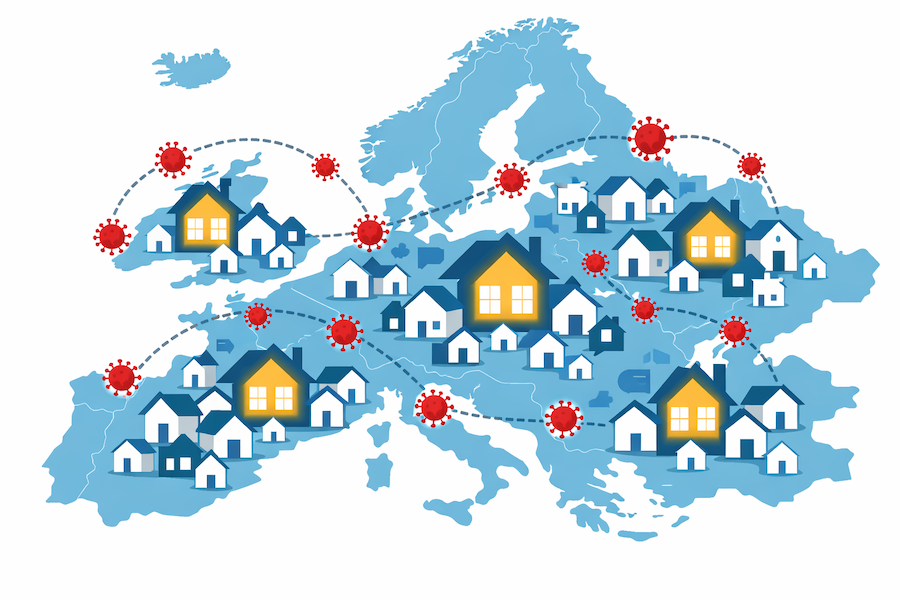
During the COVID-19 pandemic, Europe saw huge differences in how widely the virus spread from country to country. A common explanation is “policy differences” — lockdown timing, mask rules, school closures, travel restrictions, and so on. But this paper argues something more uncomfortable:
your country’s household structure may have quietly shaped the outcome from day one.
The core idea: homes aren’t just where you “stay safe”
Respiratory viruses love households because household contact is:
-
longer,
-
closer,
-
repeated daily,
-
and hard to “switch off” with public rules.
Even strict interventions mostly reduce between-household mixing (bars, workplaces, events, transit). But inside the home, transmission can still surge once the virus gets in.
So the authors break spread into two channels:
-
Within-household spread (what happens after someone brings it home)
-
Out-of-household spread (community transmission between different households)
That separation matters because it reveals a structural truth:
Countries with bigger households can hit “out of control” spread even if their community transmission is no worse than others.
The headline result: household size explains ~40% of the cross-country gap
Using data from 34 European countries and focusing on the period Jan 1, 2020 to Jun 13, 2021 (early enough that mass vaccination didn’t dominate outcomes), the study finds:
-
Household size explains about 40–41% of the variation in cumulative COVID incidence across Europe.
-
The relationship is strong: countries with larger “effective household size” tended to have higher overall incidence.
That’s a big deal because it means a huge chunk of what looked like “policy success/failure” may actually be structural advantage/disadvantage.
“Effective household size” (simple version)
The paper doesn’t just use average household size. It uses an “effective” size that also accounts for how uneven household sizes are.
In plain terms:
-
A country with lots of multi-person and multi-generational homes has more “high transmission potential” households.
-
Even if the average looks modest, the presence of many larger households increases the epidemic’s ability to accelerate.
Why bigger households force tougher interventions
Here’s the punchline logic:
-
If households amplify spread once infected, then your margin for “safe” community transmission shrinks.
-
So countries with larger households must reduce between-household contacts more aggressively to achieve the same level of control.
In other words:
-
Two countries can implement similar restrictions,
-
but the one with larger households may still see a higher cumulative hit — because each imported infection has more fuel at home.
A new lens for comparing countries: “out-of-household spread”
The authors propose using an index that measures how much transmission happens between households (the part policy can actually influence most).
When they rank countries by this “out-of-household” spread:
-
Nordic and some island countries tend to look stronger (lower between-household spread),
-
while parts of Central/Eastern Europe tend to look weaker (higher between-household spread),
though the authors stress that this reflects many factors (resources, compliance, culture, weather), not just “better decisions.”
Household size also distorts socioeconomic correlations
COVID outcomes often correlate with development indicators like HDI (Human Development Index). The authors show that household size explains a substantial portion of that correlation.
Translation: part of the “HDI vs COVID” story may be household structure hiding inside the socioeconomic package (income, housing, multigenerational living, institutional support systems).
The big takeaway for future pandemics
This isn’t just an academic curiosity. It’s a policy warning:
Households are a built-in accelerator.
If a country has larger or more multigenerational households, it may need:
-
faster response thresholds,
-
stronger measures reducing between-household mixing,
-
targeted protections for crowded housing,
-
support for isolation (space, paid leave, temporary accommodation),
-
and realistic evaluation metrics that don’t pretend all countries start from the same baseline.
The blunt conclusion:
Some countries didn’t “fail harder.” They faced a tougher structural environment — and future preparedness must account for it.
source: https://arxiv.org/pdf/2602.15447