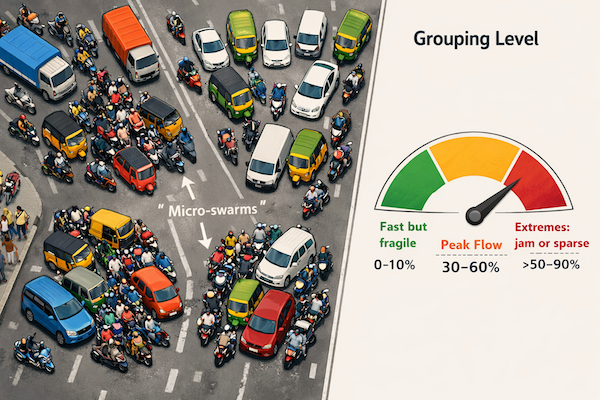
If you’ve ever watched traffic in places where lane lines are more “suggestions” than rules—think motorcycles weaving, auto-rickshaws squeezing through gaps, cars and heavy vehicles negotiating space on the fly—you’ve seen something fascinating: traffic organizes itself.
A new arXiv study (Nagahama et al., Feb 20, 2026) digs into this messy reality—called heterogeneous disordered traffic—and asks a deceptively simple question:
Do self-organized “vehicle groups” help traffic move better… or make things worse?
What the researchers mean by “vehicle groups”
This isn’t a formal convoy with rules. A “group” here is a recurring leader–follower pattern—vehicles that repeatedly behave like they’re linked (accelerating/braking in response to each other), even without lanes.
To detect groups, the authors used real-world video from Mumbai, India (Jan 2017) and extracted vehicle trajectories. They built a leader–follower network (vehicles as nodes, influence relationships as directed edges), then identified subnetworks that appear more often than you’d expect by chance using a randomized baseline. If a pattern shows up significantly more than random shuffles, it qualifies as a “group.”
Vehicle types were classified into four categories:
-
Motorcycles
-
Auto-rickshaws
-
Passenger cars
-
Heavy vehicles
Why traffic “math” needed translation (PCU)
Comparing a motorcycle to a truck by simply counting vehicles is misleading. So they used Passenger Car Units (PCU)—a normalization system that converts different vehicle types into a comparable “car-equivalent” footprint/impact.
To avoid bias from any single PCU method, they used three:
-
IP method (manual-style interpolation used in Indian capacity guidelines)
-
MLR method (regression-based: how each vehicle type affects passenger-car speed)
-
SB method (area + speed based: projected size and relative speed)
The big finding: grouping has a “sweet spot”
Across multiple analyses, one theme keeps popping:
Moderate grouping is often where the best flow happens—especially in medium-to-high density traffic.
In particular, the study repeatedly sees peak-flow points when 30–60% of vehicles are in groups.
That’s the headline: some grouping helps, but not too little, not too much.
But here’s the twist: “typical” traffic and “best-case” traffic aren’t the same
The authors used two complementary views:
-
Median (smoothed) trends: what traffic usually looks like
-
Scatter plots: the full messy distribution, including rare “high-performance” moments
These two don’t always agree.
In the median view, at intermediate densities, more grouping often correlates with lower typical flow—likely because many detected groups form during deceleration waves (the seeds of stop-and-go), which naturally reduce speed and throughput.
But the scatter view shows something powerful:
-
The highest flows are disproportionately found at moderate group proportions (30–60%)
-
Meaning: under the same density and similar grouping, traffic can run in two modes
-
a common low-efficiency mode (deceleration-driven clustering)
-
a rarer high-efficiency mode (more cooperative, stable motion)
-
That’s a big conceptual takeaway:
Grouping can either be a symptom of trouble—or a mechanism for efficiency—depending on the underlying dynamics.
Too much grouping can “polarize” traffic states
When group proportion rises beyond ~50%, the data show fewer points in “middle-of-the-road” conditions. Traffic tends to shift toward extremes—either:
-
very low density/free-flow, or
-
very high density/congestion
In plain English: high grouping doesn’t simply mean “better organization.” Sometimes it signals that traffic is getting trapped in extreme regimes.
Free-flow is different: less grouping can be better
In low-density, free-flow conditions, the study finds that lower group proportions often align with higher flow, consistent with the idea that when roads are open, tight leader–follower synchronization can be unnecessary friction.
“Is mixed vehicle composition inside groups the key?” Not by itself.
They tested whether group entropy (how mixed the vehicle types are inside a group) predicts speed. Result:
-
The entropy–speed relationship is not consistent across traffic situations.
-
One scenario (downstream-jammed, with a looser group threshold) showed a negative relationship, but it didn’t replicate under stricter definitions.
Conclusion: entropy alone is too blunt. If group composition matters, it likely depends on richer descriptors—who follows whom, spatial geometry, stability, and context.
Why this matters (beyond traffic theory)
This isn’t just academic. If group prevalence really shapes flow, then future systems—camera-based monitoring, low-cost ITS, V2X hints, intersection design, micro-lane guidance—could aim for bottom-up control:
Not “force perfect lane discipline,” but nudge traffic toward the productive grouping regime (that 30–60% zone) when density rises—while avoiding deceleration-wave clustering that kills performance.
In infrastructure-limited cities, that’s a big deal: better flow without heavy, top-down enforcement.
source: https://arxiv.org/pdf/2602.18056