One of science’s oldest mysteries is deceptively simple: How does life actually begin? For decades, researchers have tried to recreate life’s origin in laboratories, but they’ve faced a fundamental problem — they don’t even have a clear way to measure when non-living matter becomes “alive.” Without a universal measuring system, experiments can’t easily be compared, and theories remain fragmented.
This research argues that the key missing ingredient isn’t a new experiment or exotic chemical — it’s measurement itself.
Why Measuring Life Is So Hard
Scientists know life appeared on Earth billions of years ago, long before the first recognizable cells existed. Before that, there must have been a long period where molecules gradually became more organized and complex. But current scientific tools struggle to quantify this transition.
Traditional approaches focused on information — for example, how much genetic data a molecule holds. But these methods hit a wall: they often rely on assumptions about unknown possibilities or require estimating probabilities that simply can’t be calculated. In other words, they depend on information we don’t have.
The Hidden Bias Problem in Origin-of-Life Experiments
Most lab experiments searching for life’s origins start with an unintended bias: scientists design them based on modern life’s chemistry. That means researchers might unknowingly steer results toward familiar molecules instead of discovering truly natural pathways life might have taken.
Even small decisions — temperature, chemical order, purification steps — can influence outcomes. These subtle choices shape which molecules form and which don’t, making it difficult to tell whether life-like complexity appeared naturally or was indirectly guided by experimenters.
The Vastness of “Chemical Space”
Imagine every possible molecule that could exist. That unimaginably huge set is called chemical space. Even using just a handful of common elements, the number of possible molecules is astronomically large — vastly larger than all known biological molecules combined.
Early Earth was likely a chaotic chemical environment producing countless compounds. The real mystery isn’t just how life formed — it’s how specific molecules were selected from this overwhelming diversity.
A New Way Forward: Measuring Complexity Directly
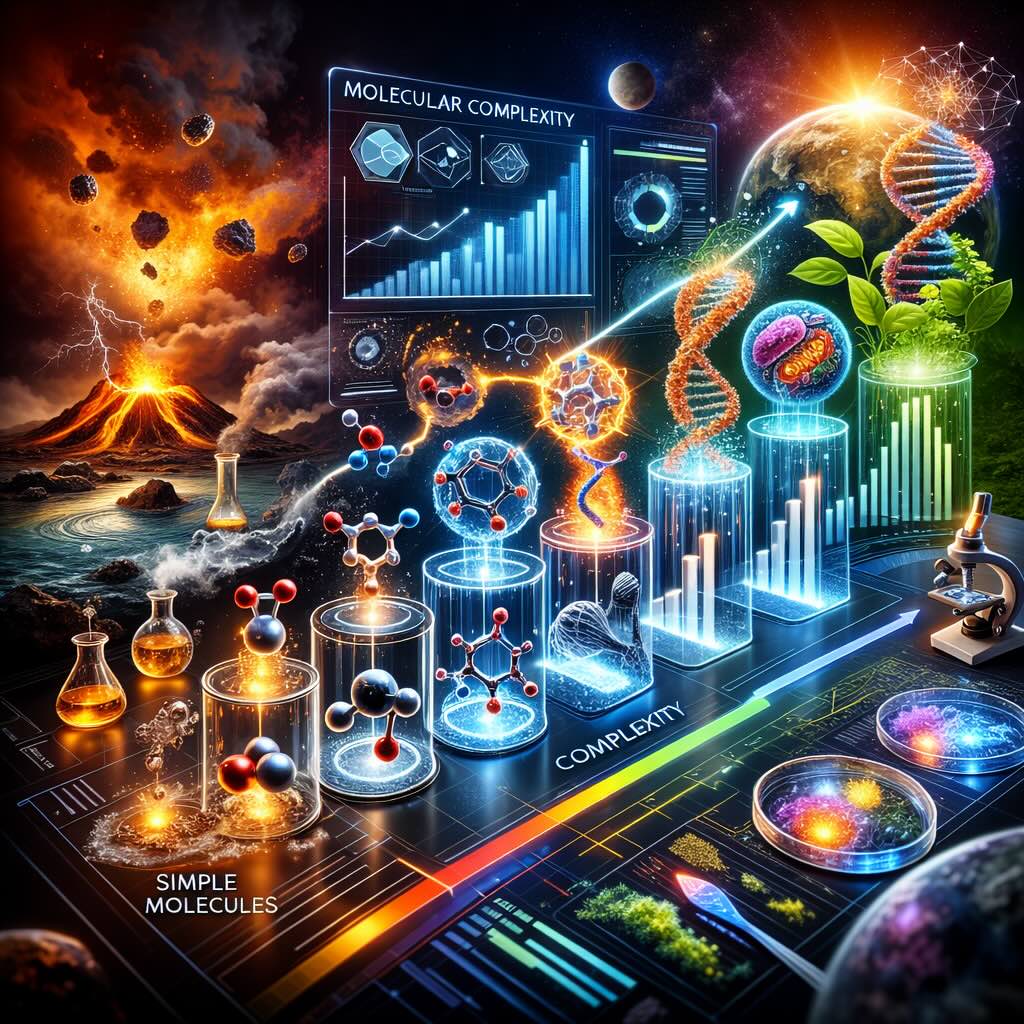
The paper highlights an emerging framework called assembly theory, which focuses on something tangible: how difficult it is to build a molecule from simpler pieces.
Instead of asking how much information a molecule contains, this approach asks:
How many steps does nature need to assemble this molecule?
This produces a measurable value called an assembly index, which scientists can determine using real laboratory instruments such as mass spectrometers and spectroscopy tools. Because it relies on physical measurements rather than abstract probabilities, it works even in messy chemical mixtures.
Early experiments suggest that molecules above a certain complexity threshold are extremely unlikely to form without biological processes. That means complexity itself could become a universal biosignature — a sign that life is or was present.
Life May Not Start in a Single Moment
Another major insight: life’s origin may not have been one dramatic event. Instead, it may have been a cascade of transitions, each step increasing molecular organization. For example:
-
simple chemical reactions →
-
self-sustaining reaction networks →
-
small molecular chains →
-
interacting polymers →
-
primitive genetic systems →
-
full cellular life
Each stage could represent a “phase shift” in complexity — similar to how water suddenly freezes or boils under the right conditions.
Why This Matters Beyond Earth
Today’s search for extraterrestrial life mostly looks for molecules associated with Earth-based biology. But alien life might not use the same chemistry at all.
A measurement-based approach could change that. Instead of searching for specific molecules, scientists could search for unusually complex molecules — regardless of their exact composition. That would allow detection of life forms fundamentally different from anything on Earth.
The Bigger Picture
This research suggests that the path to understanding life’s origin isn’t just about chemistry or biology — it’s about developing a universal science of complexity measurement. With standardized tools, scientists could finally compare experiments across labs, environments, and even planets.
If successful, this framework could unify competing theories about life’s origins and possibly lead to something science has never had before:
a universal physical theory explaining how matter becomes alive.
source: https://arxiv.org/pdf/2602.18203