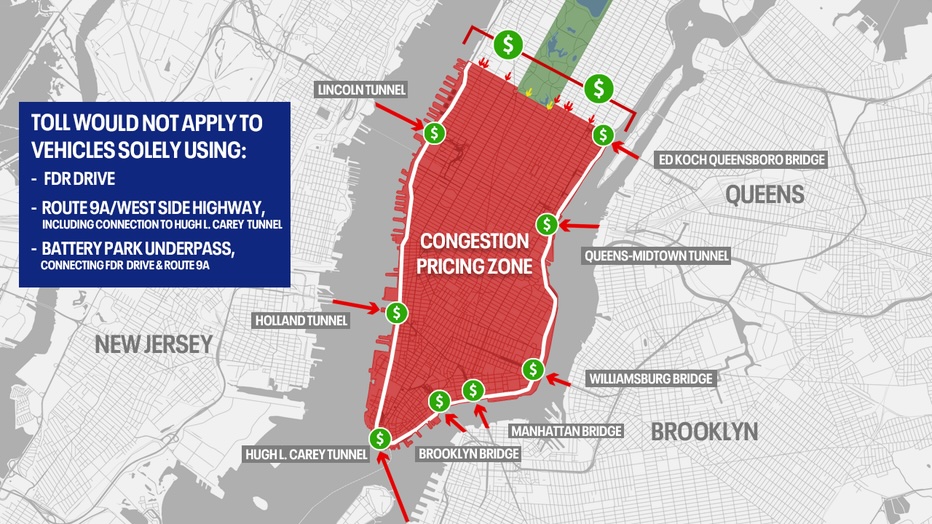
When New York City launched its congestion pricing program in January 2025, it promised faster traffic, cleaner air, and better transit. Early results suggest those promises are partly true — but a deeper analysis reveals a more complicated reality: while the city gains overall, certain communities quietly lose out.
Researchers analyzed travel behavior across the greater New York metropolitan region using large-scale synthetic trip data representing more than 70 million daily journeys. They examined how tolls affect travel choices, accessibility, and economic well-being for different groups and regions.
The Big Picture: Net Gains… With Hidden Losses
The policy works at a macro level:
-
Traffic entering the congestion zone dropped roughly 12%
-
Transit ridership increased about 9%
-
Annual toll revenue is estimated at over $500 million net
Even after accounting for reduced accessibility caused by tolls, the city still ends up ahead overall. In fact, total losses experienced by travelers are smaller than the revenue generated — meaning, in theory, the city could compensate everyone and still have money left.
But that’s only part of the story.
The Unequal Reality
The benefits and costs aren’t evenly distributed.
Biggest losses occurred in:
-
Upper Manhattan
-
Brooklyn
-
Queens
-
Nearby New Jersey counties
These areas have many commuters who drive into Manhattan but have limited alternatives. People who can’t easily switch to transit or change destinations are hit hardest.
Meanwhile, residents inside the congestion zone actually saw slight gains, mostly because reduced traffic made travel faster and more reliable.
Why Some People Feel It More Than Others
Different groups value time and money differently.
-
Higher-income commuters tend to value time savings most.
-
Lower-income travelers are more sensitive to cost.
-
Seniors and students are generally more flexible with schedules.
This means one policy can affect people very differently even if they take the same trip. For example:
-
Faster buses may benefit professionals more.
-
Fare discounts may help students and low-income riders more.
A one-size-fits-all solution simply doesn’t work.
Can the City Fix the Inequality?
Researchers tested ways to compensate affected groups using toll revenue. Two main strategies were evaluated:
1. Improve Transit Service
Reducing wait times helps everyone, especially people who value time highly.
Small improvements could offset losses:
-
About 40 seconds shorter wait times for NYC riders
-
About 2 minutes shorter waits for New Jersey commuters
2. Discount Transit Fares
Another option is subsidizing transit fares.
Estimated annual cost:
-
~$165 million for NYC residents
-
~$171 million for New Jersey commuters
Why Fairness Is Harder Than Efficiency
From a policy perspective, there are two goals:
-
Efficiency: overall benefits exceed costs.
-
Fairness: no one is worse off.
The study found:
-
Efficiency is achievable with modest investment.
-
Full fairness is extremely expensive — sometimes impossible using transit improvements alone.
Uniform fare discounts actually waste money because they overcompensate some groups while still under-compensating others.
The best solution? A mixed strategy:
-
modest transit improvements
-
targeted subsidies for specific groups
Surprising Insight: The Real Key Isn’t Just Transit
Transit upgrades alone won’t fix everything.
Some travelers — like delivery drivers or people in transit-poor neighborhoods — can’t realistically switch modes. For them, compensation might require entirely different solutions, such as:
-
off-peak delivery incentives
-
micro-transit connections
-
better last-mile options
In other words, congestion pricing is not just a transportation policy — it’s an urban equity policy.
Why This Study Matters
Most debates about congestion pricing focus on whether it reduces traffic. This research goes further by asking a harder question:
Who gains access, and who loses it?
That distinction matters because public acceptance depends less on averages and more on perceived fairness. Even a policy that benefits society overall can fail politically if certain groups consistently feel punished.
Final Takeaway
New York’s congestion pricing experiment shows that smart city policies can improve traffic and raise revenue at the same time. But without carefully designed compensation, they risk deepening inequalities between neighborhoods and income groups.
The lesson for cities worldwide is clear:
Congestion pricing works — but only if fairness is engineered into the system from the start.
source: https://arxiv.org/pdf/2510.06416