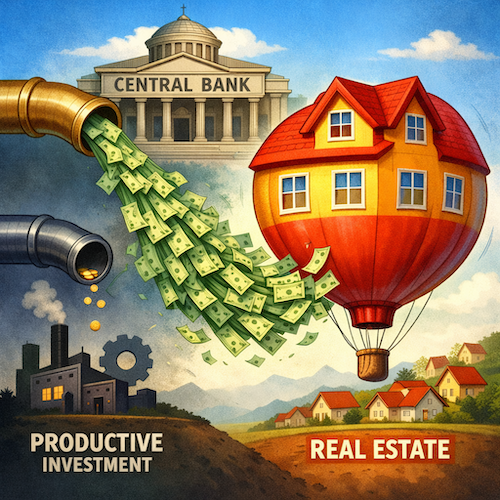
For decades, policymakers and investors have repeated the same comforting story: cheaper credit and easier money should boost growth. Lower interest rates make borrowing easier, businesses invest more, productivity rises, everyone wins.
Tomohiro Hirano and Joseph E. Stiglitz argue this story often breaks in the real world—not because credit is bad, but because where credit flows can quietly sabotage long-term growth.
The uncomfortable pattern in the data
A growing body of empirical research finds that rapid credit growth often predicts future growth slowdowns. The key detail: during many credit booms, lending doesn’t primarily fund factories, machines, or innovation. Instead, it floods into real estate and construction—the classic “safe collateral” in banking.
That shift matters because a country can look like it’s booming while it’s actually reallocating its financial firepower away from the engines of productivity.
The core idea: “Credit doesn’t just expand—it chooses a destination”
Hirano and Stiglitz build a framework where the economy has:
-
Productive investment (capital that boosts output over time)
-
Land/real estate (a valuable asset that can rise in price, and can be used heavily as collateral)
-
Money/safe saving
Their central claim is simple and punchy:
A credit boom aimed at productive capital can raise growth.
A credit boom aimed at land and real estate can reduce growth—even if it creates a big, shiny asset boom first.
Why real estate credit can be a growth trap
When borrowing gets easier—either because:
-
collateral rules loosen (banks accept more real estate collateral), or
-
monetary policy pushes interest rates down,
borrowers can lever up and buy more property. That pushes land prices up.
Here’s the catch: higher land prices don’t just make homeowners and investors richer on paper. They also pull money and borrowing capacity away from productive investment. In the model, entrepreneurs have a choice: put leverage into building productive capital… or into buying land.
When land is easier to finance than productive investment, speculation wins.
So the economy experiences:
-
a temporary boom in asset prices (and often consumption)
-
but a long-run slowdown in productivity and wage growth
The boom looks healthy. The bill arrives later.
The “Tobin Effect” flips when land exists
Classic monetary thinking (going back to Tobin) suggests that when money becomes less attractive (because inflation rises and real interest rates fall), investors shift toward real capital, lifting growth.
Hirano and Stiglitz say: that logic mostly works in a simplified world without land.
In a world with land:
-
lower interest rates can trigger a portfolio shift,
-
but the shift may go into real estate, not productive capital.
So the policy meant to stimulate long-term growth can instead inflate land prices and reduce growth—unless financial rules steer credit toward productive uses.
Winners today, losers tomorrow
One of the sharpest insights is about who benefits from these policies.
When low rates ignite a real estate boom:
-
Current landowners and leveraged buyers win (capital gains, cheaper debt, higher consumption).
-
Future generations lose (slower productivity growth → slower wage growth → lower long-term welfare).
In other words, a real estate-driven credit boom can function like a generational transfer:
today’s asset holders celebrate, tomorrow’s workers pay.
The policy takeaway: cheap money isn’t enough—credit guidance matters
The paper’s practical punchline is not “never cut rates” or “credit is bad.”
It’s:
-
Credit composition is destiny.
-
If easier money or relaxed collateral rules mainly supercharge real estate leverage, growth can suffer.
-
To make monetary easing truly pro-growth, governments need financial regulation that prevents real estate from dominating the credit pipeline—so more funds flow into productive investment instead of land speculation.
source: https://arxiv.org/pdf/2503.23552