Wireless sensing for 6G is running into a weird “good problem”: antennas are getting so large (relative to wavelength) that the classic far-field assumption—plane waves arriving with uniform phase slope—starts breaking down. In the near field, wavefronts are curved, and that curvature carries extra spatial information. If you exploit it correctly, you can estimate range and angle more precisely, and even separate parts of an extended target (think: multiple reflective points on one object) that would blur together in far-field radar.
This paper proposes a practical way to do that without building a monstrous number of antennas.
The core idea: “Huge aperture” without huge antenna count
Traditional extremely large aperture arrays (ELAAs) usually mean lots of antenna elements, often spaced at about half a wavelength to avoid angular ambiguities (grating lobes). But fully digital hardware at that scale is expensive and power-hungry—each antenna needs its own RF chain and processing.
The authors introduce ELAS (Extremely Large Antenna Spacing): instead of packing in more antennas, they space the receive antennas very far apart to create a very large effective aperture with far fewer physical elements.
-
Transmitter (Tx): stays simple and far-field. It uses beam steering (low complexity).
-
Receiver (Rx): is engineered to live in a pervasive near-field regime thanks to the giant effective aperture created by ELAS.
-
System is monostatic (Tx and Rx co-located) and uses wideband MIMO-OFDM at mmWave.
“But doesn’t wide spacing cause grating lobes?”
Yes—normally, wide element spacing at the Rx creates angular ambiguities (multiple directions look the same). The clever trick here is how the Tx and Rx spacings are paired:
-
Tx spacing: ~λ/2 (conventional)
-
Rx spacing: Nt × λ/2 (much larger)
That pairing makes the Rx grating lobes line up with the Tx pattern’s nulls, so when you look at the composite Tx–Rx response, the ambiguous lobes get suppressed. Net result: you get the benefits of a huge aperture without the typical angle confusion.
The “super-resolution region”: beating bandwidth-limited range resolution
In standard wideband radar, range resolution is mostly limited by bandwidth: more bandwidth → finer range bins.
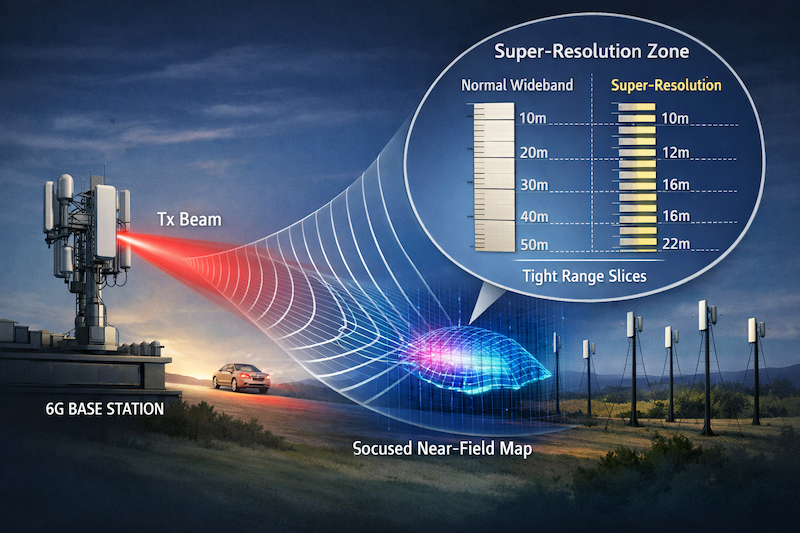
Near-field focusing changes the game. Because the Rx observes spherical wavefront curvature, it can “focus” in range as well as angle, creating a zone near the array where near-field effects dominate range resolution. The authors call this the super-resolution region:
-
Inside this region: range resolution can be better than what bandwidth alone would allow.
-
Outside this region: you revert to the usual bandwidth-limited behavior, even if you’re still technically within the receiver’s near-field boundary.
There’s an important nuance: bandwidth still matters, even inside super-resolution. If near-field focusing sets the main peak width, bandwidth helps reduce sidelobes, which means fewer false peaks and cleaner target maps.
Also counterintuitive: increasing bandwidth can shrink the super-resolution region (because bandwidth already provides good resolution, leaving less “room” for near-field to dominate).
Why this matters for real targets (not just point dots)
In the near field, treating a target as a single point reflector often fails. The paper models an extended target as a random set of micro-scatterers (small reflective points) spread over a rectangle—more realistic for vehicles, humans, drones, etc.
They then perform detection and localization using a GLRT (generalized likelihood ratio test) approach over a range-angle grid, and evaluate results with:
-
RMSE of the estimated target centroid
-
GOSPA, a metric that penalizes localization errors, missed detections, and false alarms
What the simulations show
Using a representative mmWave setup (e.g., 60 GHz, OFDM with many subcarriers, modest antenna counts like 32×32), the ELAS receiver achieves:
-
Clear localization gains when the target is inside the super-resolution region—especially at moderate bandwidths where classic range resolution would be coarser.
-
Cleaner maps (lower sidelobes) even when targets are outside super-resolution, improving false alarm behavior—this shows up strongly in GOSPA improvements.
-
A major implementation benefit: ELAS can achieve near-field performance comparable to a much denser half-wavelength array, but with ~Nt times fewer Rx elements/RF chains for similar effective focusing capability.
The big takeaway
This work argues you don’t need “XL-MIMO everywhere” to get near-field sensing benefits in 6G. With the right Tx–Rx spacing design, you can build a fully digital, lower-complexity ISAC system that still captures near-field curvature and delivers super-resolution where it matters most—close to the transceiver.
source: https://arxiv.org/pdf/2602.17702