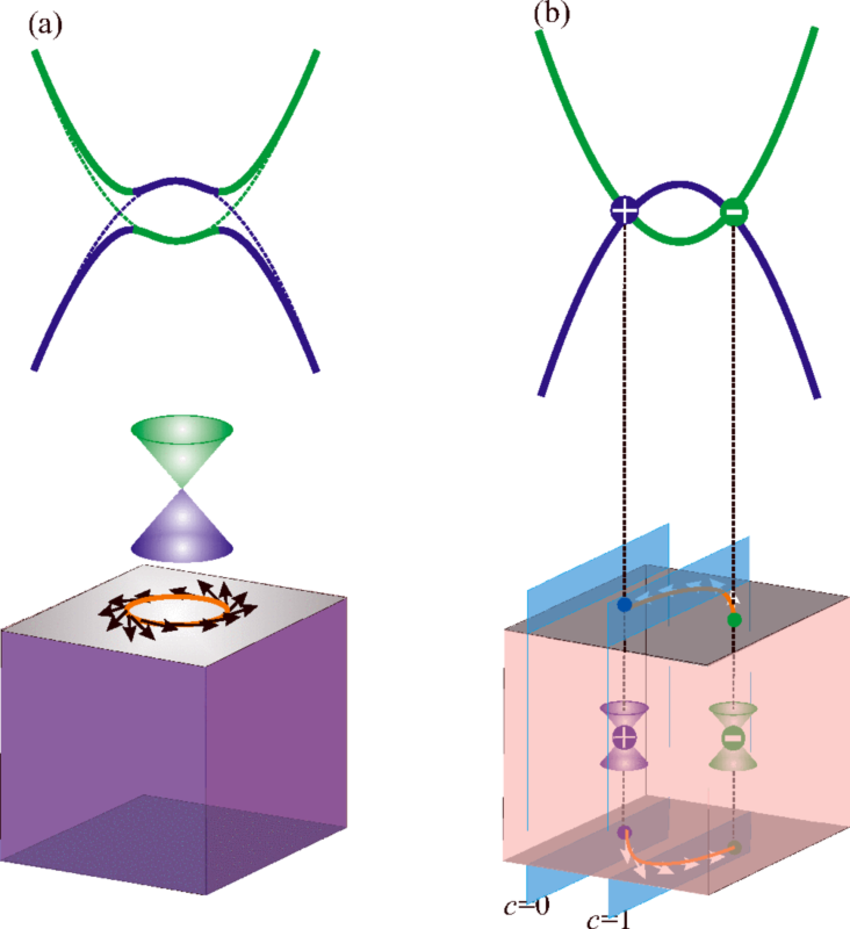
Weyl semimetals are topological materials where conduction and valence bands touch at isolated “Weyl nodes” in momentum space. These nodes behave like monopoles of Berry curvature and produce striking signatures such as surface Fermi arcs and anomaly-driven electromagnetic responses. A key detail is what happens when the chemical potential sits near the nodes (charge neutrality): the density of states (DOS) is very small, so ordinary metallic screening (Thomas–Fermi screening) is weak. That makes long-range Coulomb interactions unusually important.
Most earlier work focused on simple Weyl semimetals where the energy dispersion is linear in all directions (often called the n = 1 case). There, Coulomb interactions are “marginal” and gradually weaken at low energies, producing a marginal Weyl liquid: quasiparticles survive, but physical properties pick up logarithmic corrections rather than forming a new strong-coupling phase.
This paper tackles a more exotic family: generalized (multi-)Weyl semimetals, where each Weyl node carries a higher integer monopole charge n > 1. Crystal symmetries protect these nodes, and their dispersion becomes strongly anisotropic: linear along one direction (typically k_z) but nonlinear (order n) in the transverse plane (k_x, k_y). That anisotropy boosts the low-energy DOS, which amplifies interaction effects and raises a central question:
How do long-range Coulomb interactions reshape screening and quasiparticle coherence when the Weyl node charge is n \ge 2?
To answer this, the authors use a gauge-consistent Wilsonian renormalization group (RG) approach, carefully preserving the Ward–Takahashi identity (a non-negotiable constraint from gauge invariance). They also employ a controlled large-N expansion (with N fermion flavors), where screening is captured at leading order via an RPA-dressed Coulomb interaction, while fermion self-energy effects enter at subleading order (1/N).
Core result: an anisotropic marginal non-Fermi liquid crossover (for n \ge 2)
For higher-charge nodes n \ge 2, the interplay of anisotropic dispersion and Coulomb interactions generates a broad interaction-dominated regime at intermediate energies. In this regime:
- Coulomb screening becomes intrinsically anisotropic: the transverse sector is logarithmically dressed, while the longitudinal sector is not dressed in the same way.
- Fermions acquire a finite anomalous dimension (a hallmark of non-Fermi-liquid-like behavior).
- The quasiparticle residue is suppressed in a power-law fashion over a wide energy window, producing an anisotropic marginal Fermi liquid / marginal non-Fermi liquid phenomenology.
Importantly, the Coulomb coupling is still marginally irrelevant overall—meaning it ultimately flows toward zero—but it does so logarithmically slowly. That slow flow creates a large crossover window where interactions remain effectively strong enough to matter, even though there is no stable strong-coupling fixed point. In practice, this means experiments may observe what looks like power-law scaling over accessible energies, even if the true asymptotic scaling is “free + logs.”
Contrast with n = 1
For n = 1, the system retains an isotropic marginal Weyl-liquid character: interactions renormalize velocities and observables mainly via logarithmic corrections, but do not produce the same intrinsic anisotropic screening structure and finite anomalous dimension effects found for n \ge 2.
How to test it experimentally
The paper highlights several measurable consequences:
- Thermodynamics: specific heat and compressibility should scale with temperature with multiplicative logarithmic corrections, reflecting the slow RG flow of the effective fine structure constant.
- Optical conductivity: already anisotropic in the noninteracting theory, but interactions add direction-dependent logarithmic corrections—so \sigma_{xx}(\omega) and \sigma_{zz}(\omega) scale differently.
- ARPES (angle-resolved photoemission): the most direct signature is an anisotropic suppression of spectral weight and direction-dependent linewidth broadening, indicating reduced quasiparticle coherence in the crossover regime.
Why this matters
A lot of “interaction effects” literature in Weyl systems either assumes oversimplified screening or ignores dynamical aspects that are essential for anomalous dimensions. This work argues that once you enforce gauge consistency and account for anisotropic scaling properly, multi-Weyl systems naturally host a wide marginal non-Fermi-liquid crossover, with clear, testable anisotropic signatures.
source: https://arxiv.org/pdf/2602.17666